
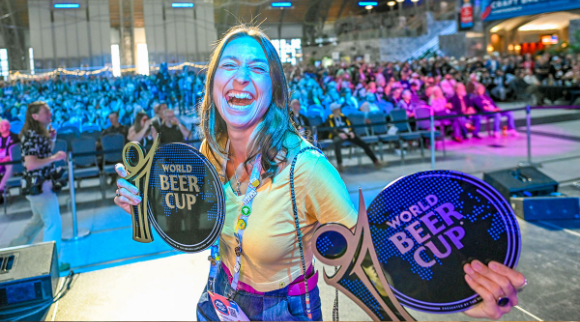
Philadelphia, April 2026. The numbers are impressive: 8,166 beers, 1,644 breweries, 50 countries, 255 judges. For its 30th edition, the World Beer Cup – alongside the European Beer Star one of the most prestigious beer competitions in the world – made a point of its global ambitions. The reality, as always, is a little more nuanced.
Of the 353 medals awarded across 118 categories, 292 went to breweries in the United States – that’s 83 percent. Not because American beer is inherently superior, but because the World Beer Cup (WBC) is, at its core, an American event: organized by the Brewers Association, held alongside the Craft Brewers Conference, and drawing entries heavily from the domestic scene. The top five entering countries – USA, Japan, Canada, China, Brazil – tell the story. Europe, as a region, barely registers in the entry counts.
That structural imbalance doesn’t diminish the competition’s credibility. Judging is blind, the panel is international, and the style guidelines are rigorous. But it does explain why the European Beer Star in Nuremberg tends to carry more weight for European breweries – lower logistical barriers, a field that better reflects the Old World’s brewing traditions, and a home crowd that knows what a Kellerbier or a Saison is supposed to taste like.
Europe’s medal haul: small but significant
European breweries claimed 16 medals in total – around 4.5 percent of all awards. Considering the distance, the entry costs, and the competition’s American center of gravity, that’s a respectable showing. And the names on the list are anything but obscure. Sixteen medals out of 353 went to European breweries. A modest slice of the pie – but a reminder that European brewing tradition travels well, even when it has to cross the Atlantic to prove it.
European medal winners at a glance
Germany
- Gold: Weihenstephaner Vitus
- Silver: Weihenstephaner Kristallweissbier
- Silver: Greif Schlöbberla – Brauerei Greif
- Silver: Ladenburger Weizenbock Hell
- Bronze: Kuchlbauer Alte Liebe
- Bronze: Kuchlbauer Aloysius
Belgium
- Gold: Tripel Karmeliet Alcohol Free
- Silver: Rodenbach Vintage
Netherlands
- Silver La Trappe Witte
Bronze La Trappe Quadrupel
Czech Republic
- Silver : Desítka, Pivovar Matuška; Kellerbier
- Silver : Desítka, Pivovar Matuška; Pale Lager
United Kingdom
- Gold: Mash Gang ‘Chug’ Hazy IPA, Non-Alcohol Beer
France
- Silver: Jong – Brasserie Spontanerie
Sweden
- Silver: Guldkällan – Spendrups Bryggeri
Lithuania
- Silver: Švyturys Ekstra Non Alko

Comments
1