
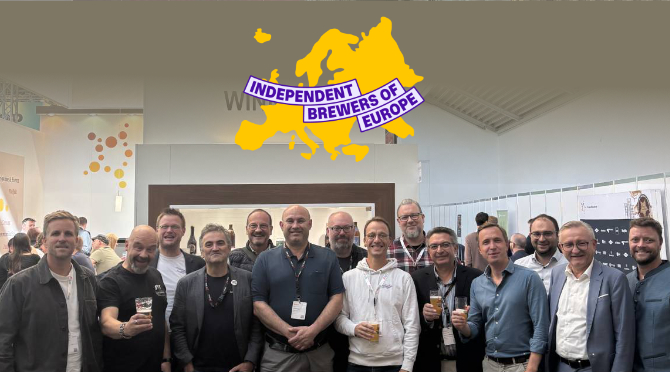
Europe's independent breweries are a force. Individually. And even more so together. Since January 2024, they have been doing exactly that under the name Independent Brewers of Europe (IBE) – an alliance of national brewing associations standing up to the growing market power of global beer corporations.
What drives the alliance is straightforward: in many European countries, one or two international corporations control the lion's share of the market. In Austria, for example, a single brewing group holds around two thirds.
IBE members do not see their engagement as a fight against corporations. Rather, they advocate for fair market conditions, transparency, and the long-term viability of small and medium-sized independent breweries. And they want beer drinkers to know who stands behind their beer.
The IBE currently brings together thirteen national associations representing more than 3,000 independent breweries.
The IBE has now published its first official report – presented on 18 March 2026 at BeerX in Liverpool. A snapshot that does not sugarcoat the seriousness of the situation – and yet shows that this industry is not waiting to be rescued. It is acting.
The 10 Key Findings
1. Survival is the priority
Four in ten independent breweries in Europe say that securing their existence is their most important task in 2026.
2. Energy is driving up costs
Brewing is an energy-intensive process – mashing, boiling, cooling, cleaning. Larger players can lock in energy prices long-term and cushion themselves against market swings. Small businesses usually cannot. They pay whatever the market demands. That is precisely why volatile energy markets hit independent breweries particularly hard – and precisely why the IBE sees an urgent need for political action here.
3. Growth? Not on the agenda for many
Around half of the breweries surveyed expect either stagnating revenues or an outright decline in 2026. Inflation, reduced consumption, increasing competitive pressure – economic conditions are making forward planning difficult, and equally so across all European countries.
4. Investing despite the crisis
In the middle of a period when survival is the focus for many, investment in the future is happening nonetheless. More than a third of breweries (37 percent) plan to prioritise improving beer quality in 2026. A further 35 percent intend to invest in new brewing equipment.
5. Small, but formative
Eight in ten independent breweries in Europe produce fewer than 4,500 hectolitres of beer per year. By comparison, a mid-sized commercial brewery reaches that figure in a matter of days. And yet – or perhaps because of this – these small operations shape their regions, their towns, their neighbourhoods. Size is no measure of social relevance.
6. The short route to the customer
More than a quarter of all beer produced – 28 percent – is sold directly to consumers: through taprooms, brewery shops, their own bars or pubs. The direct contact between brewer and drinker, the conversation, the recommendation, the story behind the beer – all of that is part of it. Privately run breweries have faces. You know the people standing at the brew kettles.
7. Part of the community
Three quarters of independent breweries actively support local initiatives and projects – sports clubs, community events, social causes. Those who are rooted in a region give back to it. That is what sets small and medium-sized breweries apart from the corporation.
8. Hyperlocal and proud of it
Just one percent of the beer produced by Europe's independent breweries is exported. The rest stays where it was brewed – in the region, in the town, at the beer garden around the corner. That is precisely what sets independent brewing apart from global mass production.
9. Younger drinkers are drinking less – but more consciously
The report confirms a trend many in the industry already sense: younger adults are reaching for beer less frequently than previous generations, and a growing share is choosing not to drink alcohol at all. But – and this is the crucial twist – when they do choose beer, they choose with care. Quality, authenticity, and regional origin are genuine purchasing criteria for this group.
10. Beer is culture – and that deserves protection
Beer is not simply a lifestyle product. It is deeply rooted in Europe's cultural heritage – shaped by centuries of craftsmanship, woven into regional identity, carried forward by each new generation that redefines it. The IBE sees itself as the voice of those who keep this heritage alive. Not out of nostalgia, but out of conviction.
The full report is available to download on the Independent Brewers of Europe website.
Photo: Independent Brewers of Europe
Kommentare
1